Tel
+86-13617990808
This article is dedicated to everyone working in the power industry—
and to anyone searching for a reliable supplier of porcelain insulators.
Some products appear ordinary at first glance,
yet quietly support the operation of half of the world’s power networks.
Porcelain insulators are exactly that kind of product.
If insulators are the “guardians” of transmission systems,
then porcelain insulators are the calm, steady veterans among them.
They do not attract attention.
They do not make noise.
But for decades, they have stood firmly in our power systems—
from low-voltage lines to EHV/UHV corridors,
from coastal regions to plateaus,
from deserts to industrial zones.
Wherever reliability and durability matter most,
porcelain insulators serve as the backbone supporting grid safety.
Today, let’s talk about the story behind this dependable workhorse.
In transmission lines, substations, switching stations—
you’ll always see rows of steady “veterans”:
light-yellow or gray bodies, thick, solid, and quietly reliable.
For those who have:
pulled conductors in strong wind zones,
inspected lines across mountains and valleys,
climbed towers at high altitudes enduring cold and low oxygen,
worked with drawings labeled “XP-70,” “U210B,” “P-15T,”
or seen hundreds of crates of insulator strings stored in warehouses…
Porcelain insulators need no further introduction.
For decades, they have taken on the most demanding responsibilities:
✔ Withstanding tens of kV up to hundreds of kV
✔ Remaining stable in rain, dust, ice, and storms
✔ Bearing mechanical tension and extreme temperature changes
✔ Preventing flashover and securing line reliability
In one sentence:
Porcelain insulators = stability + mechanical strength + long service life.
In the power industry, stability is everything.
And porcelain delivers exactly that.
Many customers ask us:
“Glass and composite insulators are evolving fast—why is porcelain still used globally?”
Because porcelain possesses fundamental engineering strengths that time cannot replace.
Porcelain is made from natural raw materials—kaolin, clay, and feldspar—
fired at 1000°C–1300°C to achieve high density and excellent electrical performance.
Their natural benefits include:
✔ No aging
✔ UV-resistant
✔ Outstanding thermal stability
✔ Mechanical strength comparable to stone
That’s why many regions—Europe, North America, Middle East, and Africa—still prefer porcelain in:
coastal areas
high-temperature regions
heavy pollution zones
Porcelain insulators are known for superior mechanical strength.
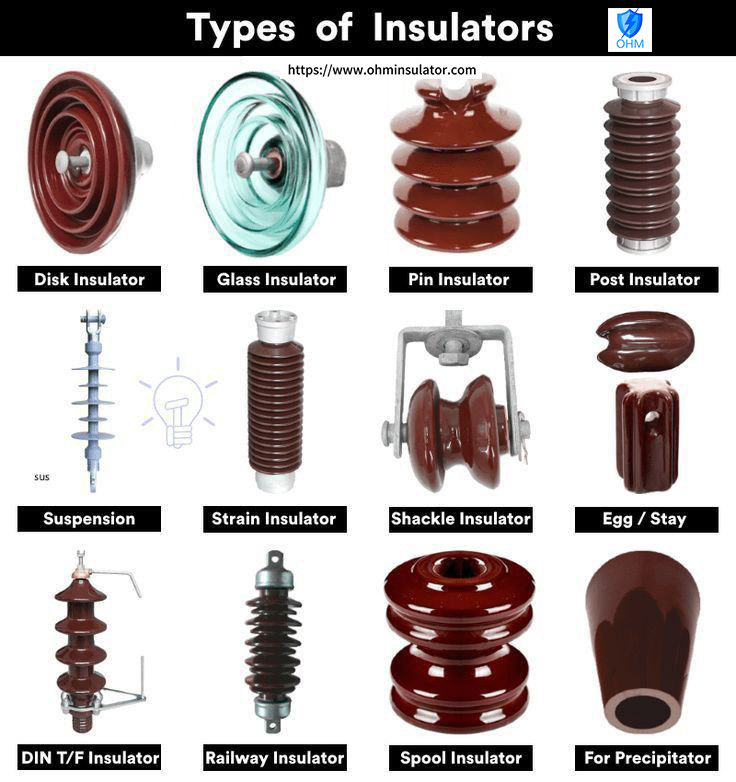
For example, ANSI 55/56/57 series pin insulators can withstand tens of kN of bending load.
They perform exceptionally in:
long-span crossings
high-wind areas
heavy ice regions
high-tension transmission lines
The harsher the environment, the more porcelain insulators prove their value.
The glazed surface (glaze coating) is its natural armor:
✔ Resistant to moisture
✔ Dirt is less likely to adhere
✔ Easily restored after cleaning
✔ Service life of decades
Many African and Middle Eastern utility clients comment:
“After cleaning once a year, the surface almost looks new.”
Porcelain’s long-term predictability is why engineers trust it.
Porcelain is preferred in scenarios that require stability, durability, and predictability:
(Qinghai, Tibet, Yunnan)
✔ Large temperature variations
✔ Strong UV exposure
✔ High wind
Porcelain’s thermal stability gives it distinct advantages.
(steel plants, chemical zones, dust regions)
✔ Resistant to corrosive gases
✔ Less aging under pollution
(crossing rivers, valleys, coastal lines)
✔ Superior bending and compression strength
(backbone transmission lines, substation exits)
There’s a saying in the industry:
“For critical locations, porcelain is always the safest choice.”
Many visiting clients ask us:
“How can ordinary clay become a product capable of withstanding hundreds of kV?”
The answer lies in an extremely rigorous manufacturing process.
We strictly control kaolin, clay, and quartz parameters such as:
✔ particle size
✔ moisture content
✔ firing shrinkage
✔ dielectric strength
Every batch is traceable to ensure consistency from the source.
Firing determines the insulator’s final strength and dielectric properties.
Too low → insufficient density
Too high → deformation or cracking
Incorrect duration → inconsistent performance
OHM INSULATOR uses fully automated temperature-controlled kilns,
with 72-hour precision firing to ensure optimal mechanical and electrical performance.
Our tests include:
✔ Power frequency withstand test
✔ Lightning impulse withstand test
✔ Mechanical bending strength test
✔ Water immersion / porosity check
✔ Glaze uniformity inspection
What looks like a simple insulator to others
is, to us, a thoroughly verified product.
Before purchasing, ensure clarity on these five factors:
China → GB
Americas → ANSI
Asia, Europe, Africa → IEC
OHM INSULATOR provides full drawings and model recommendations.
For coastal or heavy-pollution regions:
✔ long creepage design
✔ anti-pollution type
✔ high-strength glaze
Common ratings: 10 kN / 20 kN / 40 kN / 70 kN
Choose based on span and tension.
Porcelain is ideal for:
✔ high temperature
✔ large temperature differences
✔ strong winds
✔ heavy ice load
✔ high tension
OHM INSULATOR offers:
✔ complete type test reports
✔ long-term supply experience to utilities
✔ ISO-certified production
✔ full-process inspection from raw materials to finished products
These are the foundations of trust for global customers.
Every insulator may end up on:
a mountain ridge,
a valley crossing,
a coastal tower,
or a high-wind corridor.
It carries not just a serial number, but the responsibility of:
✔ stable electricity for cities
✔ reliable power for households
✔ continuous operation for industries
✔ safety of national power infrastructure
This is why OHM INSULATOR is committed to producing reliable porcelain insulators.
Every extra degree of reliability brings greater security to the power grid.
If you are looking for stable and durable insulation solutions,
OHM INSULATOR is ready to support your transmission projects worldwide.
Hotline